How many days has it been now? These days I mainly count time using empty wine bottles lined up on the kitchen floor. When recycling day rolls round I get to assess the psychological state of the neighbours too. Our building had a pretty rough stretch round about mid-April, but as we ease into May it looks like people might be starting to pull themselves together a bit more.
It’s particularly hard to keep track of time because here in Japan the sky has been falling slowly. In NYC corona arrived in a fury, storming through the city like some invisible kaijū: hurling fireballs of viral droplets, raining fomites down on the city, its tentacles lashing down Broadway while the populace cowered inside. In Japan it arrived at an almost lazy pace. First it popped its head above the water to ensnare a cruise-ship in Tokyo Bay, sucking a dozen-plus holiday-makers into the maw while they hammered on the porthole windows to get out. Then it submerged again, and for a while we hoped it had moved on.
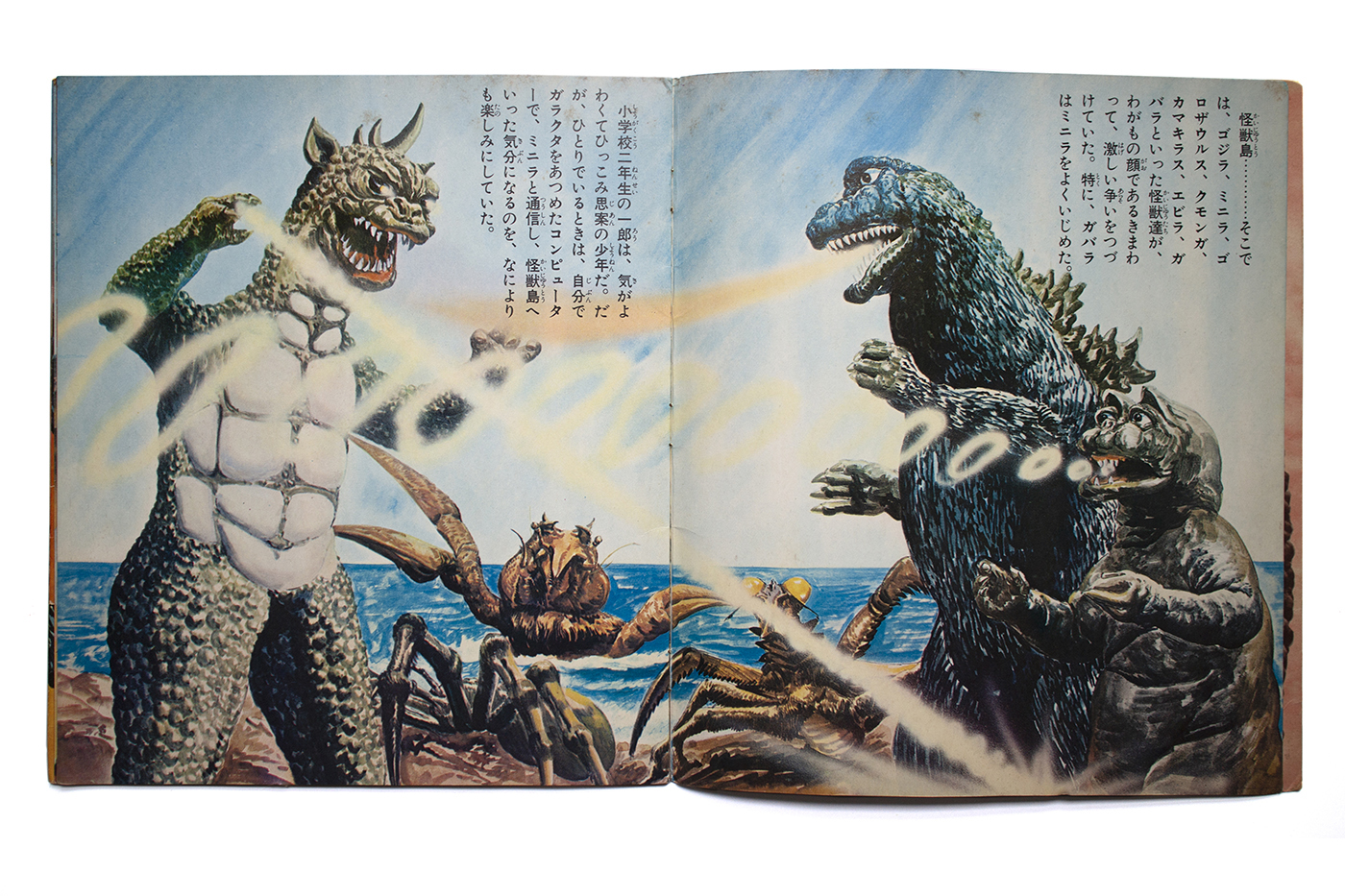
Tatsuji Kajita, Asahi Sonorama All Monsters Attack Sonosheet (1969) pp.3-4
The government did take some action, to be fair. At the start of March Prime Minister Abe ordered the schools to close, sending parents into a tizzy (I say parents, it’s been mainly mothers of course) as they struggled to work with their kids bouncing off the walls of shoebox apartments. But otherwise life seemed to go on as normal. The izakaya stayed open, station attendants kept on shoving commuters into subway carriages, and when the cherry blossoms bloomed the revellers crowded into parks to enjoy what is, for many Japanese, the most delightful proof that the earth still spins on its axis. The floating world still floated as well, with the salarymen, the bureaucrats and politicians slinking through the allies of the red light districts into snack bars, massage parlours and the more shadowy pleasure establishments. Even the pachinko parlours kept on jingling, with their ranks of bronchitic old men chain-smoking cheek-by-jowl before slot machines.
And despite all this, the infection rate only spread slowly. While the pandemic lashed the rest of the world, for a few tremulous weeks we seemed to be an island in the storm. Was Japan special? Might we be reaping the dividend of all that bowing, the mask-wearing, the alleged obedience to authority? The government certainly seemed to think so. For nearly two months they did virtually nothing to ramp up testing or expand Japan’s intensive care capacity, which is less than half that of Italy’s and one sixth of Germany’s. Instead the Abe cabinet devoted the bulk of their energies to an elaborate kabuki-dance with the IOC over the Summer Olympics (which even the most credulous Pangloss could tell was clearly doomed). The air of complacency was palpable. Not a single of my neighbours here in suburban Osaka placed any confidence in the official contagion figures. Theories swirled as they have elsewhere. COVID deaths, we suspected, were being misdiagnosed as regular ‘flu, and hospitals were refusing to take suspected cases so that victims died at home, uncounted. Some of our neighbours even subscribed to a far-fetched conspiracy theory that the government was deliberately covering up deaths from the virus.
Personally I don’t believe there was any concerted coverup. The government was merely complacent. And because they were complacent they squandered precious time when Japan might have learned from the rest of the world and made some attempt to strengthen the seawalls against the kaijū. Only when the numbers in Tokyo began to spike did they begin to panic. It was the metropolitan governors who sounded the alarm first, pleading with Abe to lockdown, turn on the money taps, or at least show some kind of goddamn leadership beyond the corporate schmoozing and half-assed macroeconomic tinkering that, after ten years in power, he thought was the only thing the top job would ever require.
Abe is the scion of the most powerful political dynasty in Japan’s history. He was born with more silver spoons jammed into his mouth than a novelty act at a nineteenth-century carnival; he sweats privilege like a runner lapping the Imperial Palace on a still afternoon in August. But somehow he has perfected a sort of man-of-the-people schtick that made him seem, to a crucial majority of voters, relatable. But during the current crisis the mask has slipped. In an attempt to convince people to stay home he put out a video on twitter showing him preening on a cream chaise longue, stroking a fluffy dog like some Bond villain skulking in the Palace of Versailles. The mockery was swift and vicious. Man of the people like hell. The atmosphere of panic that coronavirus instilled sent world leaders’ approval ratings soaring, no matter how ineptly they handled the crisis. Even Trump got a bump. Only Abe’s sagged. Let that sink in for a second.
Still, it has to be said that his government is now doing something. Maybe belatedly, but something. On April 7th, after infection rates began to spike in Tokyo, Abe finally announced a State of Emergency covering Japan’s major cities, and after some arm-wrestling from provincial governors reluctantly extended it to the whole country. In the week or so after the state of emergency was declared, shops, cafés, restaurants, and brothels slowly closed. Even the pachinko parlours eventually stopped jingling, though only after local governments publicly shamed them. Some companies have shifted to teleworking, though not nearly to the extent seen elsewhere. A stimulus package was passed – hardly money machine go brrrrrrrr like in other countries – bu at least a stuttering spigot of cash into people’s pockets to help them weather the pandemic. School closures have been extended, and no one seriously believes they will reopen again until September. Testing has ramped up somewhat, though again it lags China, South Korea, Europe and the U.S. Mask-wearing in public space, already widespread in the early days of the crisis, has become pretty much universal, despite the difficulty of obtaining the damn things. Japan has slipped into a mild version of the lockdowns that have been imposed in most of the rest of the world.
And for the moment at least, these efforts seem to have paid off. Since April 17th the number of recorded cases has dropped steadily, and also more sharply than in countries such as the U.S. and U.K. that have implemented stricter lockdowns. For this, I think we can thank the fact that, for whatever reason, coronavirus has spread relatively slowly in Japan. As a result, the official daily death toll in Japan peaked at thirty-three, compared to nearly 1,000 in Italy and Britain and 2,000 in the U.S. So far we have got off very lightly indeed.
Nor, to be honest, can I complain that much about my personal situation. While my colleagues in Manhattan huddle in their apartment buildings, some afraid to even saunter half a block to Broadway – let alone into claustrophobic plague pits like bodegas or West Side Market – out in the Kansai ‘burbs I have it pretty easy. The archives may be closed, but otherwise I can still enjoy my sabbatical in peace. I’m not hunched over a laptop like the other Columbia profs, struggling to deliver lectures to panicked students over flickering wifi. Sure, my son is driving me stir-crazy, but at least he can go out and play in the park every day. The sun shines, the first shoots of rice saplings will soon poke from the paddy-field next door, birds warble in the grove of the shrine across the road, and koi carp flags celebrating Children’s Day flutter overhead. Life here is, in the grand scheme of things, not half bad.
Still, when I lie awake at night with my Merlot-addled mind spinning and think about the advantages squandered, I want to put my fist through a wall. I think of those yawning weeks in February and March (both twenty-bottle months, since you ask) when trivial expenditures on testing, quarantining and contact-tracing could have chopped off the kaijū’s tentacles as swiftly as a sushi chef sashimis an octopus. The South Koreans were right next door across the Tsushima Strait, showing us all how it’s done. And do I believe that the government has an exit strategy? Not for a moment. With the possible exception of China, nowhere does really, does it? Everyone is still on the back foot, winging it week by week. In Japan as elsewhere the state of emergency, in some form or another, stretches on to the horizon as far as the eye can see. How many more bottles till the kaijū passes? Damned if I know.